
Edited version of speech given by Abbas El-Zein at the 2025 National Biography Award Ceremony held at the State Library of New South Wales; Abbas won the award for his book Bullet Paper Rock – A Memoir of Words and Wars.
My father’s family came from a village near the southern-Lebanese market town of Nabatieh. Much of the town was destroyed during the war in September last year, including the ancient town square where the weekly Monday market has been taking place for centuries, as well as the high-street along the Marj’youn road. Marj’youn is Arabic for Meadow of Eyes or Meadow of Water Springs, and the road leads to the Sh’eef Castle – Beaufort in English – sitting atop the exquisitely dramatic ravines of Marj’youn. Nabatieh is only 240km from Gaza, roughly the same as the distance from Wollongong to Newcastle and, over the past two years, those of us who hail from this part of the world have been overwhelmed by emotions – sadness, outrage, solidarity, helplessness – but it is a creeping numbness that I find hardest to countenance.
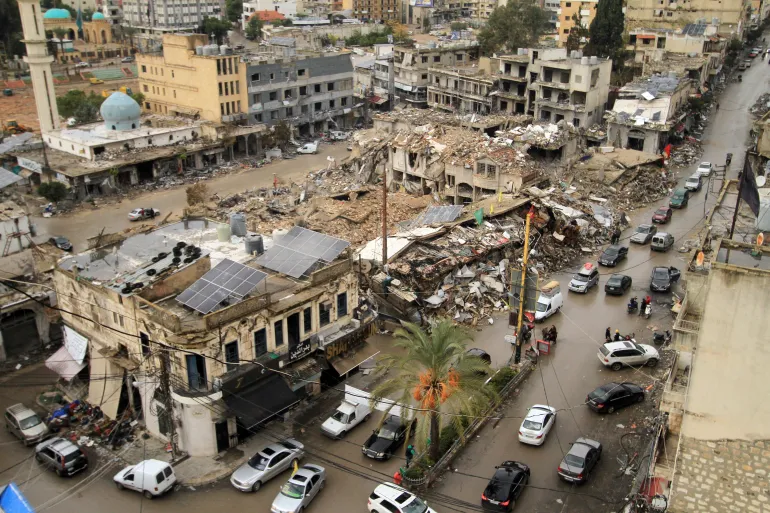
Destroyed Centre of Nabatieh (from Al Jazeera website, courtesy of Kamel Jaber)
The brutality of war does diminish our capacity to feel and speak, and this challenge of words and wars is one that I tried to take on in Bullet Paper Rock. Biography and autobiography, it seems to me, is a fertile ground on which to tackle this challenge. The word comes from the Greek “bio” for life and “graphy” for writing or recording, and the genre derives much of its power from a series of creative tensions: between the public and the private, between the need to remember and the limitations of memory, between the oral and the written, between life – the sheer, heart-beating, joy-making immediacy of it – and writing – how we make sense of life, the kind of stories we tell about it. The tension that is between the “bio” and the “graphy”.
There is no such tension in the genocide unfolding in Gaza. It is an unremitting war on life – the vicious, by-any-means-necessary extinguishing of it. And a war on writing as anti-genocide speech is censored in the Western metropolis and as Palestinian journalists are targeted – the latest being the four Al Jazeera journalists including Anas Al Sharif killed last Sunday. A war, in other words, on the “bio” and the “graphy”.
A crudely violent state led by a war criminal who is wanted by the International Criminal Court, is perpetrating the single most sustained campaign of mass murder of unarmed civilians in modern history, with the complicity or wilful blindness of most Western governments. The mass starvation of children, the callous shooting of those seeking food; the humiliation and torture of detainees; the forced marching of hundreds of thousands from one end of Gaza to another in appalling conditions; the erasure of whole cities with their hospitals, mosques, schools, universities, bakeries, markets; the targeting of health workers; the sadism of snipers picking off children. What do you call this – the furnaces of Gaza, the killing fields of Gaza, the concentration camps of Gaza? Even the charge of apartheid has become a gross understatement in describing the abominations of Gaza. Language – this most powerful of human inventions – is struggling to keep up.
But why am I talking about Gaza today as we celebrate the wonderful genres of biography and autobiography? The question, I believe, is whether biography is premised on a moral order of any kind. Can a Portuguese or British slave trader in the 18th century or a Nazi biographer in 1942 or a Khmer Rouge adherent in 1977 write a biography that we might consider a work of art, something to aspire to? Perhaps, but unlikely. What would be missing is at least one of two values underpinning the “bio” and the “graphy”, namely a belief in the sanctity of human life and an insistence on speaking the truth against the silencing impulse of power and what we have been witnessing over the past two years is an unprecedented attack on both. It is no coincidence that creators are amongst the most vocal in denouncing the genocide, sometimes at risk to their own careers, as Michelle de Kretser pointed out in her Stella Prize speech. In speaking up, they are not only taking a principled moral stance – and it is heartening to see writers refusing to be censored at the Bendigo Writers Festival over the past two days – but they are also giving voice, on behalf of all of us, to an impulse of self-preservation, because the war on Gaza, and the attempts at censorship, are a threat to the conditions of possibility of their craft.
There is a great Irish saying that the winners write the history and the losers write the poetry. Next time I am in Dublin I should remember to get some intelligence on who writes the biography, a genre that has a foot in both camps. A new world is emerging, foreshadowed by what we are seeing in Gaza. Will we still be able to write the biographies we value today? Or will AI-bots do the job, while their cousin-drones are busy killing and maiming their pre-vilified victims, with both bots and drones manned by the same supercomputers in Palo Alto, Tel Aviv, Amsterdam, Beijing or Moscow? Or will we instead continue to live in a world largely shaped by our values?
No one knows, but in the meantime, we can insist on a few certainties. The certainty that we must speak up for life so that the genre we love can continue to prosper. That we must record, one way or another, the more than 61,000 biographies cut short in Gaza, or at least honour them with a measure of justice for the unspeakable crimes committed against them. And the certainty that every life and every act of recording matters because when we are momentarily silenced by war and power, together we become, like that road in Nabatieh, a meadow of eyes – seeing, witnessing, remembering – and this they can never take away from us. END
*I gave this speech on 16 August 2025 at the State Library of New South Wales, alongside my fellow shortlisted writers Sam Elkin, Kate Fullagar, Matthew Lamb, Barbara Minchinton, Philip Bentley and Nikos Papastergiadis. The speech opened with an acknowledgment of country: “I’d like to acknowledge the Gadigal people of the Eora nation and pay my respects to their elders, past and present. I am thrilled and honoured to be on the same shortlist as my fellow authors, let alone to win this award. Thank you to the judges, Sylvia Martin, Lech Blaine and Eda Gunaydin, to Susan Hunt, the State Library of NSW Foundation and all sponsors of the award, to my publisher Terri-ann White and my agent Jane Novak. Bullet Paper Rock is a memoir about war, about the Arabic language, but also about family and I’d like to pay tribute to my late mother and father who pulled off the feat of raising a family of six children in the midst of war. I will read a small excerpt about my father from a chapter in Bullet Paper Rock called ‘Insight’.”